
Mindset is a Differentiator
3 min read
TL;DR (Too long; Didn’t read)
We live in a VUCA world: volatile, uncertain, complex, ambiguous. Mindset is how you navigate it.
What a team measures shapes its behaviours, and its behaviours reinforce its mindset.
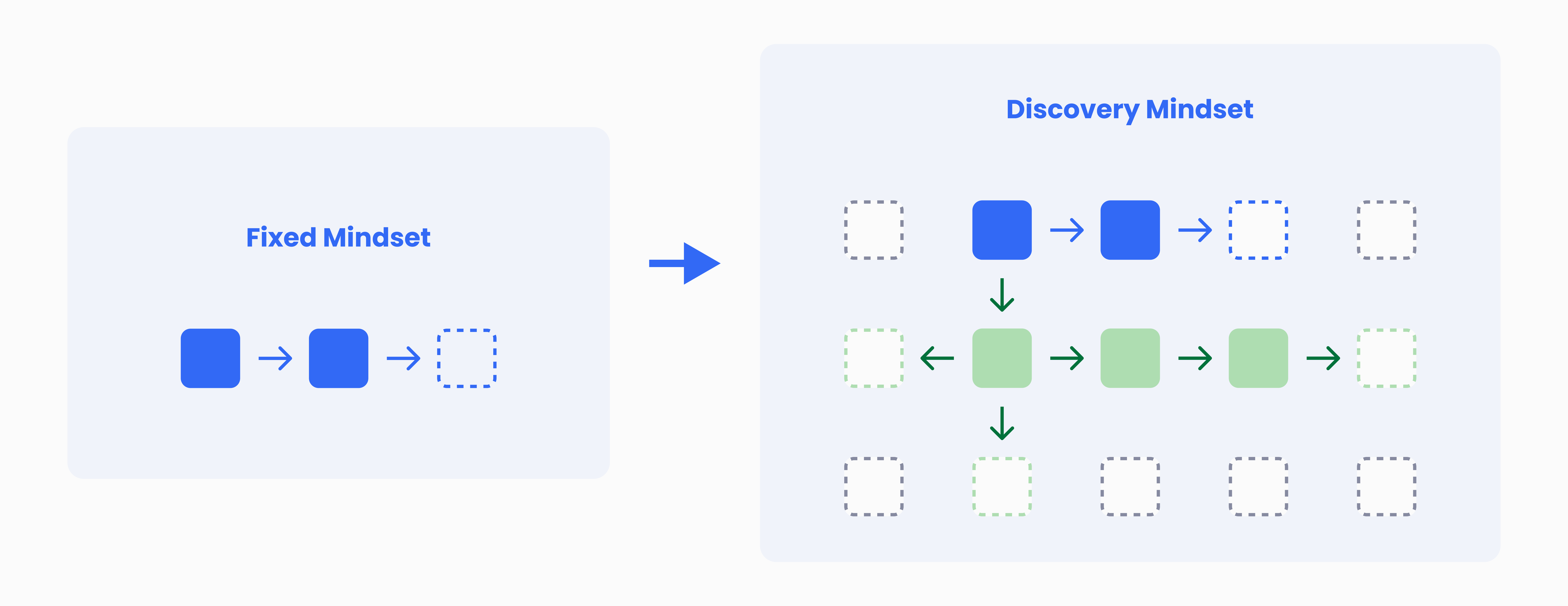
Fixed mindset teams optimise for certainty. Discovery mindset teams optimise for learning.
The shift from fixed to discovery mindset is the hardest and most valuable change a team can make.
Thinking is the highest form of leverage we have.
Michael Jordan was not the tallest player on the court. Roy Keane was not the most technically gifted midfielder in the Premier League. Johnny Sexton was not the biggest out-half in the history of rugby. Katie Taylor is not the most physically imposing boxer of her generation. Rory McIlroy did not have the most natural swing when he turned professional.
What separated all of them, what made them exceptional, was mindset.
If you have watched The Last Dance on Netflix, you have seen it up close. Jordan’s win-at-all-costs mentality was not a quirk. It was a competitive edge, systematically applied, every single day. The same is true of Keane driving standards at United, Sexton grinding through injury after injury to lead Leinster and Ireland, Taylor outworking every opponent, McIlroy turning mental discipline into major championships.
In sport, we accept this truth without argument. In business, we still spend most of our time talking about tools, processes, and technology. We are asking the wrong question.
Why mindset matters right now
We use the acronym VUCA to describe the environment most organisations are operating in today: Volatile, Uncertain, Complex, Ambiguous. AI, geopolitical shifts, changing customer expectations, rapid technology cycles. The world is not getting simpler.
In that environment, a fixed mindset, one that seeks certainty, plans in straight lines, and measures what is easy to measure, is a liability. A discovery mindset, one that stays curious, tests assumptions, and treats ambiguity as information, is a genuine competitive advantage.
That is why at Acend, one of our core principles is: adopt a discovery mindset in everything you do.
How to spot a fixed mindset (it is hiding in plain sight)
Here is something we look at when we work with teams: the relationship between what they measure and how they behave.
We call this the mindset loop. How we think about the world, and work in particular, leads us to create measures that indicate progress, and practices and behaviours that help us hit those measures. All three, mindset, measures, and mechanics, form a system of work. And like any system, it is self-reinforcing.
If a team believes in certainty, they will measure for it. You will see delivery dates treated as success metrics, Gantt charts used as the primary planning tool, and progress defined as on time, on budget. These are not bad practices in isolation. But as a system, they quietly reinforce a belief that the world is knowable, predictable, and controllable.
That belief is exactly the thing that fails in a VUCA environment.
The opposite, a discovery mindset, shows up differently. Teams measure learning velocity, not just delivery velocity. They run experiments. They treat unexpected results as signal, not failure. Their planning is iterative, not linear.
This is why we use mindset surveys as a diagnostic. Not to judge teams, but to make the invisible visible, to surface the assumptions baked into how they work before we try to change anything.
The WWII mechanic who grounded the fleet
During World War II, General George Marshall received reports from the Pacific: pilots were refusing to fly. The information coming back was vague, something about safety, something about the aircraft. Low-fidelity information. It told him what was happening, but not why.
Marshall did something smart. He sent a trusted person to the airfield to observe directly.
On the ground, the real issue was obvious. Mechanics were working at night under floodlights, swarmed by mosquitoes. Many were sick with malaria; others were impaired by their antimalarial medication. Their workmanship was suffering. The pilots could see it and they stopped trusting the planes.
The solution was not a new briefing. It was not a tougher order. It was a supply change. Ship mosquito nets. Protect the mechanics. Restore trust. The planes flew again.
High-fidelity information, seeing the system rather than just hearing about it, changed everything Marshall thought the problem was. This is discovery mindset in action. Not assuming you know the answer. Going to find out.
Dave Snowden’s framework: knowing which problem you have
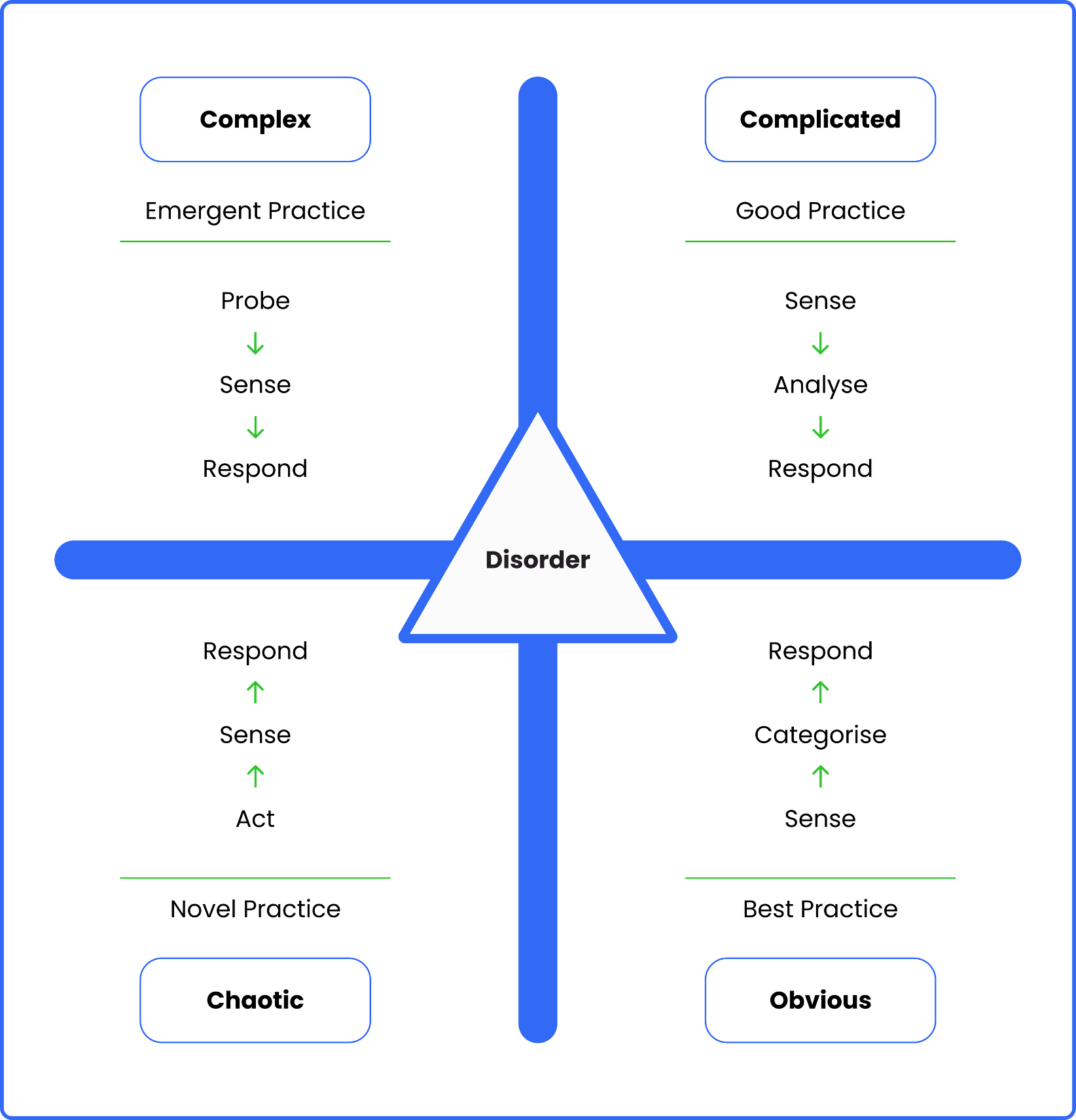
The complexity researcher Dave Snowden developed the Cynefin framework to help leaders understand the nature of the problems in front of them. The core insight is simple: not all problems are the same, and treating a complex problem like a simple one is one of the most common and costly mistakes organisations make.
In complex environments, which is most of where modern product and transformation work happens, there are no right answers in advance. You have to probe, sense, and respond. You have to discover.
A fixed mindset tries to apply known solutions to unknown problems. A discovery mindset starts by asking: what kind of problem is this, really?
Thinking is the highest form of leverage
We often talk about leverage in business. What is the highest-value thing you can work on? Technology is leverage. Capital is leverage. People are leverage. But beneath all of it, mindset is the multiplier.
A great process in the hands of a fixed-mindset team will deliver mediocre results. The same process in the hands of a discovery-minded team will be questioned, improved, and eventually replaced with something better.
Jordan did not just work harder than everyone else. He thought differently about what it meant to compete. That is the thing that is almost impossible to copy, and it is the thing that compounds over time.
Thinking, we believe, is the highest form of leverage we have. And mindset determines the quality of that thinking.
“It’s not the will to win that matters, everyone has that. It’s the will to prepare to win that matters.”
- Paul “Bear” Bryant
Ready to shift your team’s mindset?
Most organisations don’t have a delivery problem. They have a thinking problem. At Acend, we run mindset diagnostics, discovery sprints, and leadership coaching that moves teams from fixed to discovery, fast.
Book a call today: acend.com
Got a moment? Let us know how we did with a quick star rating!